

What I’m Learning From Writing on Jung (and Why It’s Taking So Long)
On Jung’s Red Book, learning curves, and the problem with rushing understanding

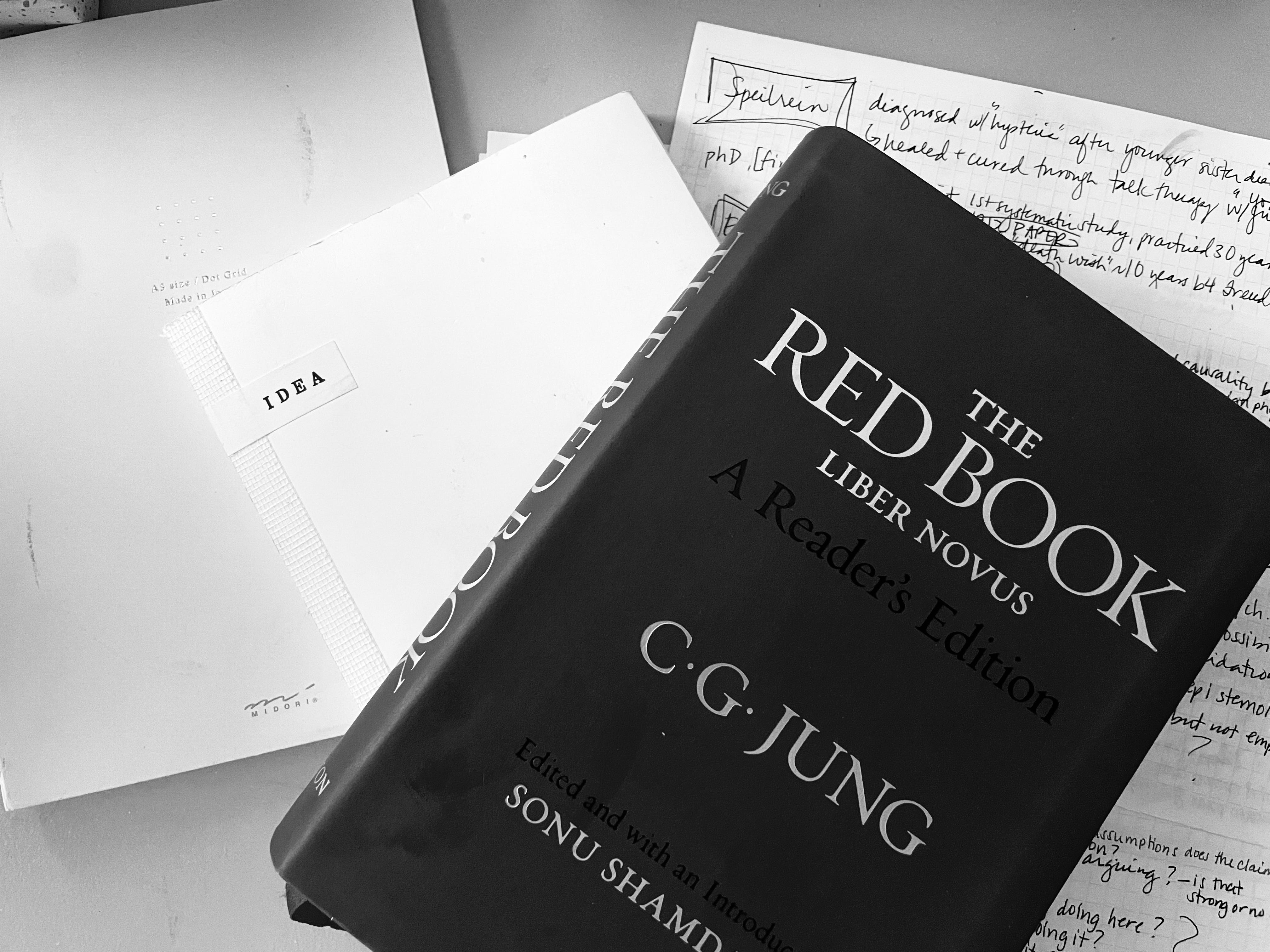
I’m writing my next paper — a critical commentary — for my master’s degree on Carl Jung’s Red Book. Essays like this are often boring, tedious, citation-scary. But I love this in a way that feels almost impractical.
I want to hole up in a corner with snacks and just drink this book’s prose. It’s strange, unsettling, alive. It’s also academically demanding in a way that doesn’t reward rushing.
But so far, most of my time wasn’t spent writing the essay at all. It was spent figuring out how to write: how to approach a primary text critically without flattening it, how to stay rigorous without disappearing into jargon, how to create an acceptable framework that would hold the words I most want to say.
I eventually landed on a simple four-part structure for critical commentary — one that lets me be precise without being punitive to the text or to myself. That took far longer than I expected.
(This is the same moment many of us reach in life — when being smart and capable no longer helps, and something slower has to take over.)
Part of me keeps wondering: does everyone else already know how to do this?
Maybe some do.
But most are probably in the thick, muddy middle, too, living what it actually looks like to truly learn something instead of performing competence.
Either way, I’m opening the document today. We’ll see what happens.